
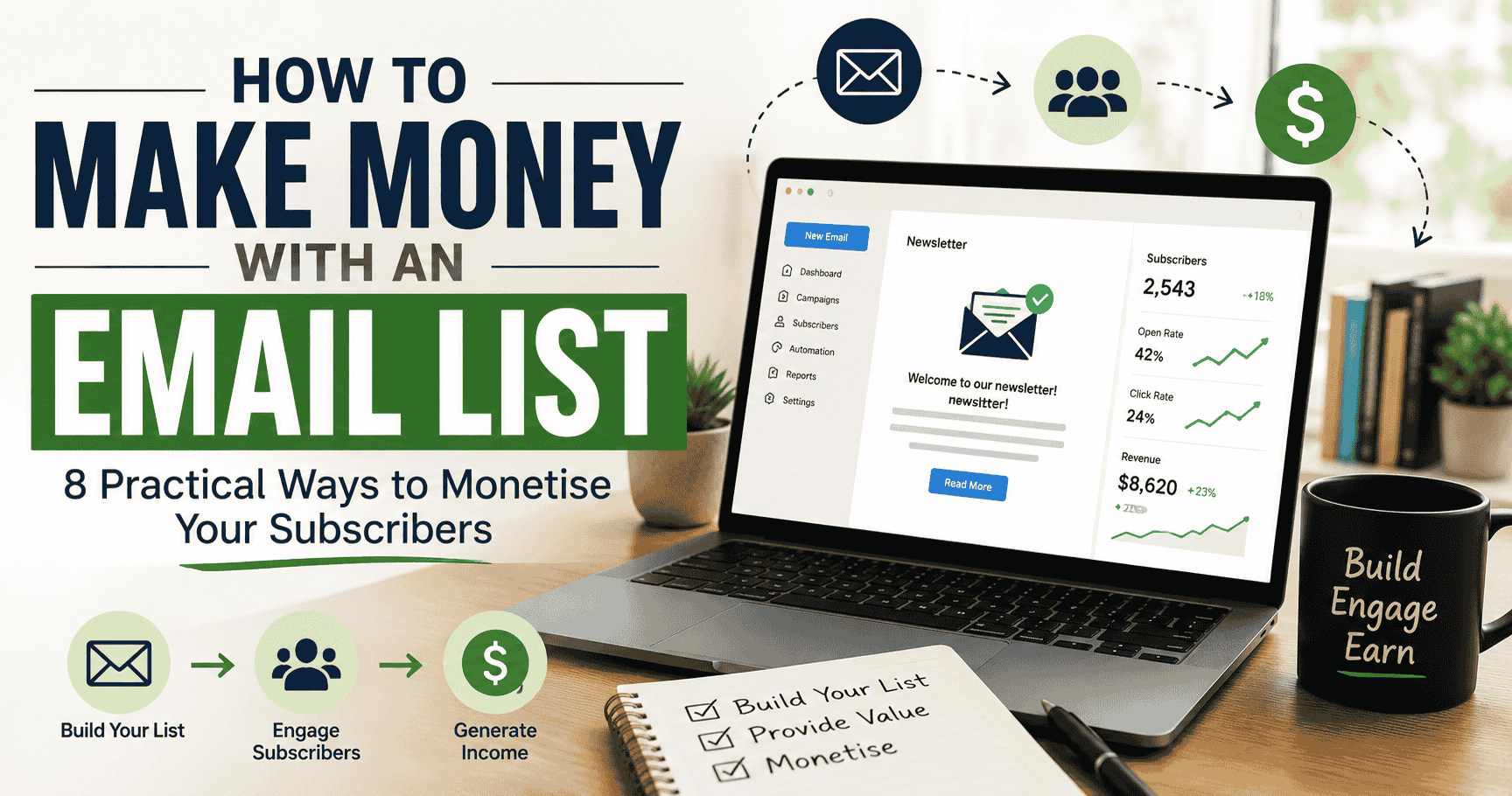
If you’ve spent any time learning about email marketing, you’ve probably heard the phrase “the money is in the list.”
There’s a reason it has stuck around.
Unlike a social media following, an email list gives you a direct way to communicate with people who have chosen to hear from you. You aren’t completely dependent on an algorithm deciding whether your latest post deserves to reach your audience.
And email can be remarkably valuable. Research from Litmus has estimated an average return of around $36 for every $1 spent on email marketing, although actual results vary considerably between businesses and campaigns.
But simply collecting email addresses doesn’t make money.
The value comes from building trust, sending genuinely useful emails and then matching your subscribers with products, services or offers that solve problems they actually have.
If you’re wondering how to make money with an email list, here are eight practical approaches you can use.
Disclosure: Some links on this page are affiliate links. If you purchase through one of these links, Guides for Marketers may earn a commission at no additional cost to you.

1. Promote Relevant Affiliate Products
Table of Contents
Affiliate marketing is one of the simplest ways to monetise an email audience because you don’t need to create a product yourself.
You recommend a useful product or service and receive a commission when somebody purchases through your affiliate link.
The important word here is relevant.
If you have an audience interested in digital marketing, for example, you might recommend:
- email marketing software
- website hosting
- SEO tools
- design software
- online courses
- marketing books
- productivity tools
Don’t choose products simply because they offer large commissions.
A smaller commission from a product you genuinely believe will help your readers is much more valuable in the long run than damaging their trust for a quick sale.
That trust is ultimately one of the most valuable assets your email list gives you.
Important: If you receive commissions from products you recommend, clearly disclose the affiliate relationship to your readers.
2. Sell Your Own Digital Products
One of the biggest advantages of building an audience is eventually being able to create something specifically for them.
Digital products can include:
- PDF guides
- ebooks
- checklists
- templates
- worksheets
- swipe files
- planners
- spreadsheets
- resource packs
You don’t necessarily need to start with an enormous course or a 200-page ebook.
Suppose you run a marketing website and your subscribers repeatedly struggle with finding profitable niches.
You might create a practical Niche Research Workbook that takes them through the process step by step.
An article can answer the initial question. Your downloadable product can help the reader actually complete the task.
That’s an important distinction.
The best digital products don’t merely contain more information. They help people achieve an outcome.
3. Introduce a Low-Cost Tripwire Offer
A tripwire is a relatively inexpensive product offered to new subscribers, usually after they have downloaded something free.
Imagine someone joins your list to receive a free checklist.
Instead of immediately trying to sell them a $200 course, you could offer a useful $7 or $15 resource that expands on the checklist.
The objective isn’t simply making a few dollars.
You’re giving subscribers an opportunity to become customers with a relatively low-risk first purchase.
If the product delivers genuine value, you’ve established something important: they now know what it’s like to buy from you.
That can make future purchasing decisions easier.
4. Sell a Service
You don’t need thousands of subscribers or your own product catalogue to monetise an email list.
Sometimes the fastest route is simply offering something you already know how to do.
Depending on your expertise, that could include:
- consulting
- coaching
- copywriting
- website design
- SEO
- video editing
- email campaign setup
- social media management
- landing-page creation
A relatively small email list containing the right people can be far more commercially valuable than a huge list of disengaged subscribers.
For service businesses especially, one good client can be worth more than hundreds of small affiliate commissions.
5. Create a Paid Newsletter
If your free emails consistently save people time, uncover useful information or provide expertise they can’t easily find elsewhere, a paid newsletter can become another revenue stream.
The key is having a clear reason to upgrade.
Your free newsletter might contain useful general advice while paid subscribers receive something more specialised, such as:
- detailed research
- industry analysis
- exclusive tutorials
- curated opportunities
- case studies
- templates and resources
- premium reports
Don’t rush this.
Build an audience that actually looks forward to receiving your free emails first. A paid newsletter becomes much easier to justify once readers already understand the value of your work.
6. Create a Course or Workshop
Some problems need more than an article or PDF.
That’s where courses and workshops become useful.
If subscribers repeatedly ask you how to accomplish something complicated, you can package your knowledge into a structured learning experience.
For example:
Free article: How to Build an Email List
Free guide: Email List Starter Checklist
Paid workshop: Build Your First Email Funnel
Full course: Email Marketing From Zero to Your First 1,000 Subscribers
Notice how each product represents a deeper level of help.
You aren’t inventing random things to sell. You’re helping the same person progress further towards the same goal.
7. Run Paid Webinars
A live webinar can work particularly well when people benefit from demonstration, interaction or the opportunity to ask questions.
You could run a session teaching people how to:
- create a landing page
- research keywords
- build an email automation
- find affiliate programmes
- launch a digital product
- use a particular marketing tool
Webinars can generate revenue directly through ticket sales, but they can also support another offer.
For example, you might provide a free educational webinar and introduce an appropriate course, service or product near the end.
Either way, the majority of the webinar should provide genuine value rather than functioning as a disguised sales pitch.
8. Offer Sponsorships and Advertising
Once you’ve developed an established newsletter with a clearly defined and engaged audience, businesses may pay to reach your subscribers.
That could take the form of:
- newsletter sponsorships
- dedicated sponsored emails
- classified advertisements
- sponsored recommendations
Advertisers will generally care about more than the raw number of subscribers.
The quality and relevance of your audience, open rates, clicks and previous campaign results can all influence the value of a sponsorship.
A focused newsletter with 3,000 highly engaged subscribers in a commercially valuable niche may be much more attractive than a general list containing tens of thousands of people who rarely open an email.
What About Solo Ads?
Solo ads involve sending a dedicated promotional email to your audience on behalf of an advertiser.
If you’re interested in how solo ads work from the list-building side, I’ve put together a separate guide on how to build an email list fast using solo ads.
They can generate revenue, but I wouldn’t make them the foundation of an email business.
Every promotional message effectively spends a little of the trust you’ve built with subscribers.
If you send too many unrelated promotions simply because somebody is willing to pay for access to your audience, engagement can deteriorate quickly.
If you do accept a solo advertisement, make sure the offer is appropriate for your audience and clearly identify promotional or sponsored content.
How Many Subscribers Do You Need to Make Money?
There’s no magic number.
You don’t necessarily need 10,000 subscribers—or even 1,000—to generate your first revenue.
Consider a creator with 500 engaged subscribers.
If ten people purchase a $19 digital guide, that’s $190.
If one subscriber becomes a $500 consulting client, that’s $500.
If subscribers purchase useful products through affiliate links, that creates another potential revenue source.
A small, targeted and engaged audience can therefore outperform a much larger but poorly matched list.
Focus first on quality, relevance and trust.
The Simple Email Monetisation Model
If you’re starting from scratch, don’t try all eight strategies simultaneously.
A simple progression might look like this:
Step 1: Create something genuinely useful people can download for free.
Step 2: Build an email list around a clearly defined problem or audience.
A simple landing page is often all you need to start collecting subscribers. If you’re using GetResponse, here’s my step-by-step guide to creating a GetResponse landing page.
Step 3: Send useful emails consistently.
Building the list is only the beginning. These email marketing tips can help you create emails that keep subscribers interested and engaged.
Step 4: Recommend relevant affiliate products where appropriate.
Step 5: Create a small digital product based on problems your subscribers repeatedly encounter.
Step 6: Introduce higher-value products or services once you understand what your audience wants.
This creates something far more sustainable than constantly looking for another quick way to make money online.
Choosing an Email Marketing Platform
You’ll need an email service provider to collect subscribers, send campaigns and automate parts of the process.
One option is GetResponse, which combines email marketing with landing pages, signup forms, automation and other marketing tools.
If you’re considering the platform, you can read my full GetResponse software review for a closer look at its features and whether it’s the right choice for your email marketing needs.
GetResponse also operates an affiliate programme. Its current programme starts qualifying affiliates at a 40% commission rate for a referred customer’s first 12 months, with higher tiers available based on referral performance.
That makes it particularly relevant to marketers who both use email software and create content about digital marketing.
GetResponse currently offers a 14-day trial of its premium features, so you can test the platform before deciding whether a paid plan is appropriate.
Disclosure: Some links on this page are affiliate links. If you purchase through one of these links, Guides for Marketers may earn a commission at no additional cost to you.
Final Thoughts
Learning how to make money with an email list isn’t really about finding one clever monetisation trick.
It’s about building an audience that trusts you and then creating sensible ways to exchange value.
For one business that might mean affiliate marketing.
For another it might be consulting.
For Guides for Marketers-style creators, it could be a combination of affiliate recommendations, free resources and practical paid PDF guides.
Start with the audience.
Learn what they’re trying to accomplish.
Help them achieve small wins for free.
Then create products and services that help them go further.
That’s where the real value of an email list begins.