

Choosing the right affiliate programs can make a significant difference to your results as an affiliate marketer.
You can create excellent content and attract the right audience, but if the products you promote aren’t relevant, trustworthy or commercially worthwhile, turning that traffic into income becomes much harder.
The good news is that finding affiliate programs doesn’t have to involve randomly searching through hundreds of offers.
If you’re wondering how to find affiliate programs in your niche, here are five practical methods you can use to uncover relevant opportunities.
1. Start With Products You Already Know
Table of Contents
If you haven’t chosen your niche yet, work through this finding your niche checklist first to narrow down a market that fits your interests, experience and opportunities.
One of the easiest places to begin is with products and services you already use.
Think about your niche and ask:
- What products do I regularly use?
- Which tools would I genuinely recommend?
- What brands do people in this niche already buy?
- Which products repeatedly appear in my content?
- What problems does my audience need products to solve?
For example, imagine you run a website about pressure washing.
You might already own a pressure washer you’ve used extensively. Instead of starting by asking which affiliate program pays the biggest commission, start with the product.
Search for the Brand’s Affiliate Program
Visit the manufacturer’s website and look in the footer for links labelled:
Affiliates, Partners, Referral Program or Affiliate Program.
If you can’t find anything, search Google using:
[brand name] affiliate program
or:
[product name] affiliate program
Some companies manage their affiliate programs directly, while others use an affiliate network.
Check Retailers Too
The manufacturer isn’t your only option.
If the product is available through established retailers, investigate whether those retailers operate affiliate programs.
This gives you another way to monetise recommendations even when the manufacturer doesn’t have a direct program.
Starting with products you actually understand also makes it much easier to create authentic content around them.
2. Search Affiliate Networks
Affiliate networks connect publishers and creators with businesses looking for partners.
Instead of applying separately through dozens of unrelated systems, you can use these marketplaces to discover brands and programs across many industries.
Some established platforms include:
- Awin
- CJ Affiliate
- impact.com
- ClickBank
If you’ve used ShareASale in the past, be aware that the platform closed in October 2025, with customers and affiliate activity transitioned to Awin.
If you’re considering ClickBank, it’s also worth understanding what the ClickBank Gravity Score means before choosing which products to promote.
Each platform has different merchants, approval requirements, commission structures and tools.
Once you’ve joined a network, search using terms related to your niche.
If your website covers home improvement, for example, you might search for:
pressure washers
power tools
garden equipment
home improvement
outdoor cleaning
Don’t stop after finding the first relevant program.
Compare several possibilities.
What Should You Compare?
Commission percentage is important, but it shouldn’t be your only consideration.
Look at factors such as:
- commission rate
- cookie or referral period
- average order value
- conversion potential
- payment terms
- brand reputation
- product quality
- available promotional materials
- restrictions on how products can be promoted
A 50% commission isn’t necessarily better than a 10% commission.
If nobody wants the high-commission product, you won’t make much money promoting it.
Likewise, a trusted product with a lower commission may convert considerably better.
Your goal isn’t to find the highest-paying affiliate program.
It’s to find the best combination of audience relevance, product quality, conversion potential and commission.
3. Research What Successful Competitors Promote
Competitor research can reveal affiliate opportunities you might otherwise miss.
Search Google for commercial queries in your niche.
Using our pressure-washer example, you could search:
best pressure washer
best pressure washer for driveways
pressure washer reviews
best electric pressure washer
Look at established websites ranking for these searches.
Which products do they recommend?
Which retailers do they link to?
Which brands appear repeatedly?
You don’t need to copy their content or recommendations. You’re simply researching the commercial ecosystem surrounding the niche.
If several successful publishers repeatedly promote products from the same retailer or manufacturer, investigate whether that company has an affiliate program.
Examine Affiliate Links Carefully
Sometimes you can identify the affiliate network or retailer from the destination URL or disclosure on the website.
You can also search:
[brand name] affiliate program
after discovering the brand through competitor research.
This turns competitor analysis into a source of potential partnerships rather than merely a way to generate content ideas.
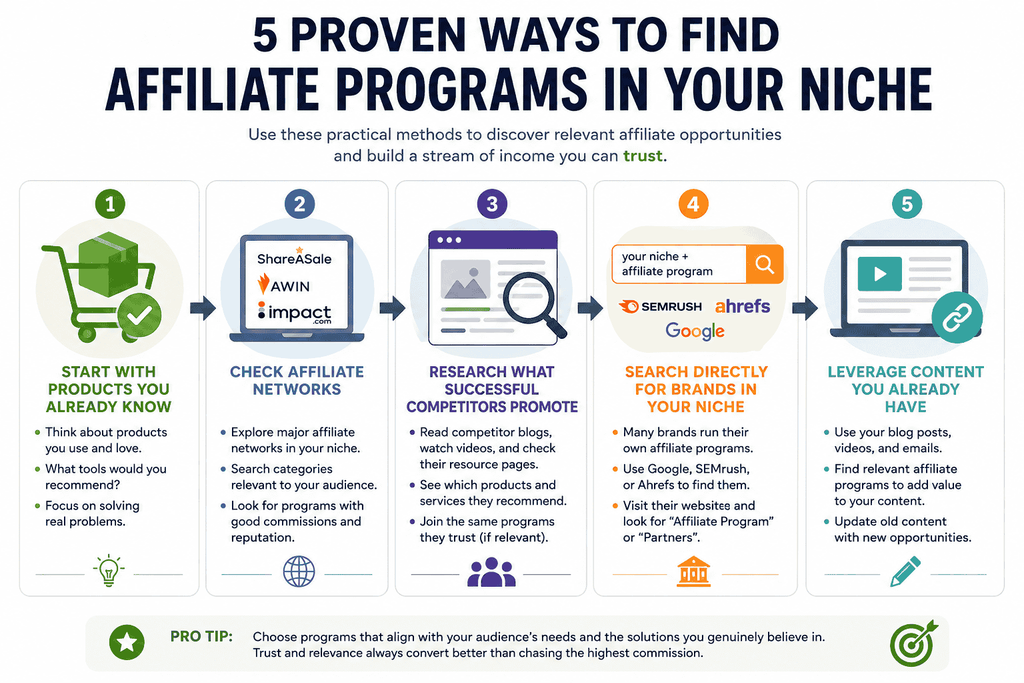
4. Search Directly for Brands in Your Niche
Don’t assume every worthwhile affiliate program will appear prominently inside a major network.
Make a list of brands operating within your niche.
Then search individually for:
[brand] affiliate program
[brand] partner program
[brand] referral program
If you’re still deciding which market to target, it helps to understand how to find low competition niches before you start researching individual affiliate programs.
You can also combine niche terms with affiliate searches:
fitness affiliate programs
gardening affiliate programs
email marketing affiliate programs
photography affiliate programs
This can uncover specialist programs that broader searches miss.
Another useful approach is to look at businesses already appearing in your niche’s Google results, YouTube videos, newsletters, podcasts and industry publications.
You’re essentially asking:
Which businesses are already spending money to reach this audience?
Those businesses may be worth investigating as potential affiliate partners.
5. Let Your Existing Content Reveal Opportunities
One of the most overlooked methods is to examine content you’ve already created.
Look through your most useful articles and identify places where readers naturally need a product, service or tool.
Suppose you’ve written an article explaining how to build an email list.
Readers may need:
- email marketing software
- landing-page software
- WordPress plugins
- design tools
- website hosting
- lead-generation tools
Those needs immediately give you potential affiliate categories to research.
This approach is particularly powerful because you’re not forcing an affiliate product into unrelated content.
You’re finding products that naturally help the reader take the next step.
How to Evaluate an Affiliate Program Before Joining
Finding a program is only the beginning.
Before promoting it, ask several questions.
Is the Product Relevant?
Would someone consuming your content realistically benefit from the product?
If not, the commission doesn’t matter.
Would You Recommend It Without a Commission?
This is one of my favourite tests.
If you wouldn’t recommend the product without being paid, think carefully before recommending it because you’re being paid.
Is the Company Reputable?
Research the business.
Look at customer feedback, refund policies, product quality and how the company handles complaints.
Your audience associates your recommendation with you, not just the merchant.
Are the Terms Reasonable?
Understand how and when commissions are earned.
Check:
- commission rates
- cookie duration
- minimum payout
- payment schedule
- prohibited traffic sources
- geographic restrictions
- rules surrounding paid advertising
- email and social-media promotion policies
Affiliate terms can change, so check the program’s current conditions rather than relying on an old blog post or screenshot.
Don’t Rely on One Affiliate Program
Once you find something that converts, it can be tempting to build your entire monetisation strategy around it.
That’s risky.
Companies can:
- reduce commissions
- change attribution rules
- close affiliate programs
- change networks
- discontinue products
- reject particular promotional methods
Diversifying across a small number of relevant programs reduces your dependence on one company.
That doesn’t mean stuffing ten affiliate links into every article.
It means building a business that doesn’t collapse because one merchant changes its terms.
Always Disclose Affiliate Relationships
If you earn money when readers purchase through your links, clearly disclose that affiliate relationship to your audience..
Don’t hide the disclosure on an obscure page that readers are unlikely to see.
A simple statement can be enough:
Disclosure: Some links on this page are affiliate links. If you purchase through one of these links, Guides for Marketers may earn a commission at no additional cost to you.
Transparency isn’t merely a compliance exercise.
It helps build trust with your audience.
Content Still Comes First
Finding the perfect affiliate program won’t compensate for weak content.
Successful affiliate content starts with helping the reader make a better decision or solve a genuine problem.
That might mean:
- comparing products
- explaining how something works
- answering common questions
- creating tutorials
- reviewing products you’ve actually used
- helping readers choose between alternatives
Finding good programs is only one part of the process. If you want to see how the pieces fit together, my affiliate marketing blueprint walks through the broader strategy step by step.
Affiliate links should support useful content rather than being the reason the content exists.
Final Thoughts
Learning how to find affiliate programs in your niche becomes much easier when you stop searching only for the biggest commissions.
Start with products you know.
Explore established affiliate networks.
Research what successful publishers in your niche promote.
Search directly for relevant brands.
And examine your existing content for products and services your readers genuinely need.
Then evaluate each opportunity based on relevance, trust, product quality and commercial potential.
The best affiliate program isn’t necessarily the one promising the highest percentage.
It’s the one that connects your audience with something genuinely useful while giving you a fair return for making the introduction.